
Satin vs Matte Car Wrap: What’s the Difference?
The main difference between a satin vs matte car wrap comes down to light reflection: a satin car wrap offers a smooth, semi-reflective sheen that diffuses sunlight across body lines, while a matte car wrap completely absorbs light for a flat, non-reflective, tactical appearance.Choosing between a satin vs matte vinyl wrap dictates how ambient light interacts with your vehicle’s sheet metal, how easy the film is to clean daily, and how visible micro-scratches or fingerprint smudges will be over time.
What Does a Satin Car Wrap Look Like in Real Life?
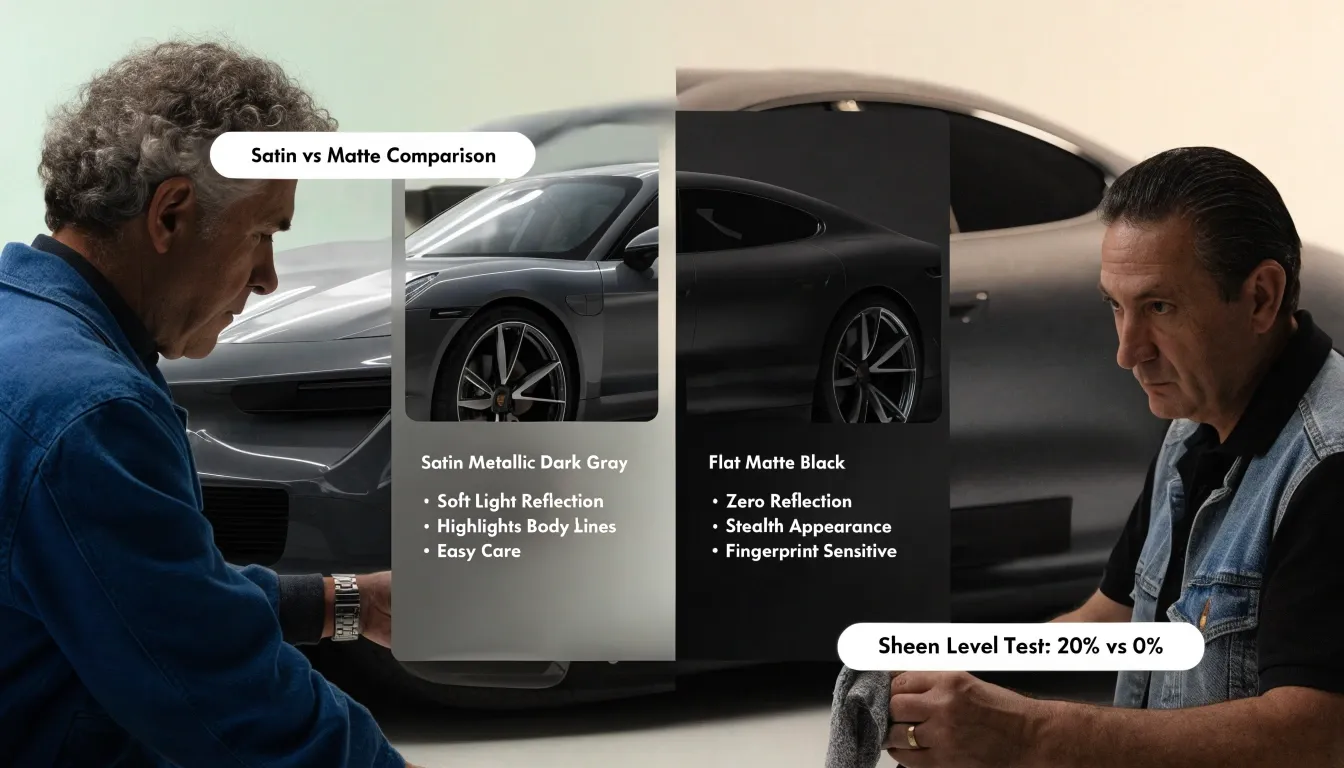
A satin car wrap provides a liquid-brushed finish that falls directly between full gloss and flat matte.
Full Gloss (High Reflection) ➔ Satin Wrap (Diffused Soft Sheen) ➔ Matte Wrap (Zero Reflection)
In natural daylight, a satin finish car wrap glows rather than reflects. When sunlight strikes the hood or doors, the film diffuses directional glare into a soft, satin sheen. This creates a silk-like texture across fender arches and body panels, giving both sports cars and luxury sedans a refined, OEM-plus look.

What Does a Matte Car Wrap Look Like?
A matte car wrap eliminates reflection entirely, creating an ultra-flat, stealthy silhouette.By absorbing ambient light, a matte finish car wrap removes directional glare, highlights, and mirror-like clear-coat reflections. This gives the vehicle an aggressive, tactical, or prototype-inspired road presence. A matte vinyl wrap emphasizes overall body contours, making coupes, hatchbacks, and performance SUVs look grounded and muscular.

Which Looks More Glossy: Satin or Matte?
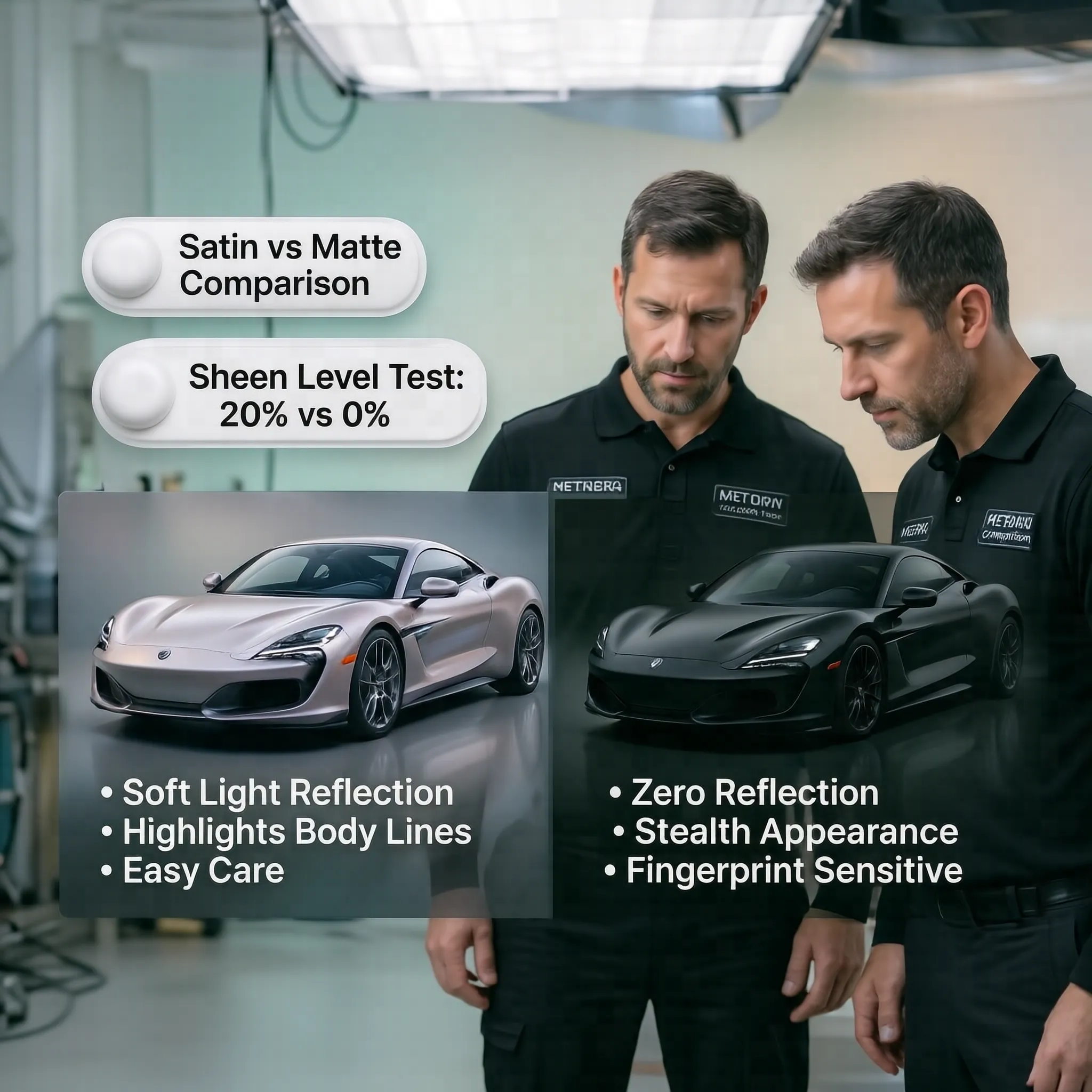
When comparing a satin vs matte finish side-by-side, satin is noticeably more reflective than matte.
| Finish Metric | Satin Vinyl Wrap | Matte Vinyl Wrap |
|---|---|---|
| Light Reflection | Moderate, soft diffusion sheen | Zero, completely flat light absorption |
| Glance Sheen | Silk-like, liquid-brushed appearance | Dry, velvet-like, non-reflective surface |
| Highlighting Power | Accentuates sharp creases and body edges | Emphasizes smooth overall body shapes |
| Fingerprint Resistance | Moderately resistant to light oils | Highly susceptible to skin oil smudges |
| Everyday Maintenance | Moderate; washes like standard vinyl | Meticulous; requires specialty matte shampoos |
While satin carries enough soft reflection to highlight subtle body contours, matte absorbs incoming light rays completely, offering no gloss or sheen whatsoever.
How Satin and Matte Wraps Change the Look of Body Lines
The way a surface reflects light alters how your eye perceives your vehicle’s bodywork:Satin Wrap Appearance: The semi-reflective sheen pools along panel edges, door creases, and hood vents. As you walk past the car, light sweeps smoothly across the metal, making sharp styling lines pop.Matte Wrap Appearance: Without light reflections to guide the eye across body seams, a matte finish flattens panel transitions. This creates a bold, continuous silhouette that emphasizes the vehicle’s overall muscle and width rather than individual panel creases.
Satin vs Matte: Which Finish Works Better With Your Car Color?
Selecting the right finish depends heavily on your choice of underlying pigment:
Matte Black vs Satin Black
Satin black is widely considered the ultimate choice for daily drivers because its subtle sheen highlights fender flares and hides finger oils. Matte black provides an aggressive, stealth look, but requires constant maintenance to prevent oily smudges.
Bright & Vibrant Wrap Colors
Vibrant colors—like Riviera Blue, Speed Red, or Acid Green—pop dramatically under a satin wrap finish. The soft sheen keeps bright pigments lively under direct sun, whereas a matte finish on bright shades can sometimes look washed out.
Dark & Earthy Wrap Colors
Dark tones—such as Midnight Navy, Forest Green, and Charcoal Gray—look exceptional in both finishes. Satin wrap colors give these shades a metallic, liquid-brushed depth, while matte wrap colors yield an industrial aesthetic.
Which Is Easier to Keep Looking Clean: Satin or Matte?
For daily drivers, a satin wrap is significantly easier to keep clean than a matte wrap.Everyday dirt, fingerprint oils, and water spots are far more noticeable on flat matte vinyl than on satin vinyl.Satin Wrap Maintenance: A satin vinyl wrap resists fingerprint oils and skin smudges much better than matte. Dust and road spray wipe off easily during routine washes without leaving uneven spots.Matte Wrap Maintenance: A matte vinyl wrap acts like a sponge for natural oils. Touching a matte door or hood with bare hands leaves dark, oily smudges that require quick cleaning with a dedicated matte detail spray.

Are Matte or Satin Car Wraps Harder to Maintain?
Proper care for both finishes requires specific detailing protocols to prevent permanent surface damage:
Hand Wash ONLY ➔ pH-Neutral Non-Wax Shampoo ➔ Dedicated Matte/Satin Detailer
No Waxes or Polish: Never apply traditional car wax, liquid polish, or clay bars to a matte or satin wrap. Fillers and gloss-enhancers will create permanent shiny patches on non-glossy vinyl.Specialized Cleaners: Practice proper matte vs satin car care using dedicated matte-safe, wax-free car wash soaps.Gentle Drying: Use soft microfiber towels or an air blower to prevent friction, which can cause why is my car wrap lifting along exposed panel edges.

Do Matte and Satin Wraps Show Scratches and Marks Differently?
Surface marks affect these two non-gloss finishes in distinct ways:Scratches on Matte Wrap: Because matte vinyl lacks a glossy clear layer, light scuffs or fingernail marks can burnish the surface, creating permanent shiny streaks that cannot be buffed out with traditional polish.Scratches on Satin Wrap: Satin wrap scratches are less visible under direct sun because the surface sheen naturally diffuses light glare, hiding minor micro-swirls.To protect both finishes from UV degradation and surface scuffs, proper solar protection is essential. Learn how heat impacts wrap longevity in can sun damage a car wrap?.

How Long Do Satin and Matte Car Wraps Last?
Under typical driving conditions, both premium satin and matte cast vinyl wraps carry an expected lifespan of 5 to 7 years.Satin Wrap Lifespan: Satin films tend to age slightly better outdoors because their semi-reflective surface sheds a portion of direct radiant solar heat.Matte Wrap Lifespan: Matte films absorb UV rays directly due to their non-reflective structure. Parking in shaded areas or using UV-blocking wrap sealants prevents premature drying, cracking, and vinyl wrap fading.Addressing issues like what causes vinyl wrap to shrink early helps both finishes reach their full lifespan.

Satin or Matte: Which Car Wrap Finish Fits Your Style?
When deciding whether to choose matte or satin wrap, match the finish to your driving habits and aesthetic goals:Choose Satin If: You want a sleek, modern finish that accentuates your vehicle's sharp body lines, resists fingerprint smudges, and offers low-maintenance daily driving.Choose Matte If: You want a bold, head-turning, stealth appearance, love a flat tactical aesthetic, and don't mind spending extra time detailing your vehicle with specialized matte care products.
Preview Satin and Matte Wraps on Your Car Before You Decide
Struggling to figure out whether satin or matte looks best on your specific car? Don't worry—you don't need to guess or rely on small 2-inch swatches to see which finish suits your vehicle's curves.Instead of stressing over tiny samples, eliminate the guesswork visually.Using an advanced car wrap visualizer, satin wrap visualizer, or matte wrap visualizer at carwrap.style, you can instantly compare satin and matte finishes directly on photorealistic 3D models of your exact vehicle make and model. Effortlessly discover which finish fits your build before ordering vinyl rolls or scheduling shop time.

Frequently Asked Questions: Satin vs Matte Car Wrap
What is the fundamental difference in light reflection between satin and matte car wraps?
The difference comes down to reflectivity: a satin wrap features a smooth, semi-reflective finish that diffuses incoming light softly across body panels, whereas a matte wrap completely absorbs light, creating a flat, non-reflective profile with zero gloss or sheen.
Does a satin or matte wrap make a car look more gloss-like?
A satin wrap is noticeably closer to gloss than matte. While matte vinyl absorbs every light ray for a dull, velvety look, satin carries a subtle, brushed-metal glow that reveals reflections without creating harsh glare.
Which finish is better at accentuating body lines and sharp fender curves?
Satin wraps excel at defining body lines, door creases, and hood scoops. Its semi-reflective sheen travels across panel edges as the vehicle moves, highlighting muscular contours. Conversely, a matte finish flattens panel transitions, emphasizing the car's overall silhouette rather than individual styling creases.
Is a satin vinyl wrap or a matte vinyl wrap easier to keep clean on a daily driver?
Satin wraps are significantly easier to maintain. Skin oils, fingerprint smudges, dry road dust, and water spots stand out sharply on flat matte surfaces, requiring immediate detailing. Satin wraps resist skin oils much better and allow light environmental film to blend in smoothly without leaving obvious dark patches.
Why do fingerprint oils show up so quickly on matte wrapped cars?
Matte vinyl possesses a microscopically porous or textured top layer designed to scatter light in all directions. When bare skin touches a matte surface, natural body oils fill those tiny microscopic pores, flattening the light-scattering effect and creating a dark, shiny spot that remains visible until washed with a wax-free cleaner.
Can you polish or wax a satin or matte vinyl wrap to remove light marks?
No. Applying traditional car wax, liquid polish, paste wax, or buffing pads to a satin or matte wrap will permanently ruin the finish. Polishing compounds use abrasives to smooth out surfaces, which creates uneven, glossy patches on non-glossy vinyl that cannot be undone.
What type of car wash soap should be used to clean satin and matte wraps?
Always use a pH-neutral, wax-free, gloss-free car shampoo. Soaps containing gloss enhancers, wash-and-wax additives, or silicone protectants will deposit shiny residues over flat surfaces, ruining the uniform satin sheen or matte texture.
Are micro-scratches and wash swirls more noticeable on satin or matte wrap finishes?
Micro-swirls are rarely visible on either finish compared to high-gloss wraps because neither reflects direct, sharp light. However, if a deep scratch cuts into the material, matte wraps are harder to blend or touch up because any friction applied to the area burnishes the surrounding vinyl into a shiny mark.
Which lasts longer when parked outdoors: Satin Black or Matte Black?
Satin wraps generally offer slightly better outdoor durability. Because satin surfaces reflect a small portion of radiant solar heat, they experience less extreme surface temperature spikes than matte wraps, which absorb UV radiation fully. Proper UV sealants help both finishes achieve their full 5 to 7 year lifespan.
Does a satin or matte wrap work better with bold, bright wrap colors?
Satin finishes bring bright pigments—like Speed Red, Acid Green, or Riviera Blue—to life by adding a silk-like sheen that pops under direct sunlight. Matte finishes on bright colors tend to mute color intensity, making vibrant shades look somewhat dull or pastel.
Can ceramic coatings be applied over satin and matte vinyl wraps?
Yes, provided you choose a specialized matte/satin ceramic coating. These formulas add a hydrophobic, dirt-repelling protective layer over the vinyl to shield against bird droppings and water etching without altering the low-sheen or flat aesthetic of the wrap.
How can I compare satin and matte finishes on my actual vehicle model before buying?
Instead of relying on tiny 2-inch vinyl sample swatches, test both textures digitally. Use a digital car wrap visualizer to switch between satin and matte finishes directly on photorealistic 3D models of your exact make, model, and year before ordering material or booking shop time.