
This guide completely eliminates the confusion. By the end, you’ll know whether a full wrap or a partial wrap fits your build, budget, and goals
Look at your ride right now.
Is it giving you that same rush of excitement as the day you picked it up? Or has the factory finish started to fade into the background?
When you get bored of your car, you hit a major crossroads. You know you want a head-turning visual transformation, but you face a critical decision: Should you invest in a full car wrap, or strategically accent specific panels with a partial vehicle wrap?
Picking the wrong option burns cash. A partial job on the wrong body style can look incomplete, while a full wrap on a daily driver might exceed what you actually need.
Here is the ultimate breakdown of full wrap vs. partial wrap—helping you choose the right setup, optimize your budget, and lock in absolute visual dominance.
What Exactly Is a Car Wrap? (Full vs. Partial Defined)
Before spending a dime on vinyl film, it helps to understand what exactly a car wrap is and how human eyes process automotive design. Your eyes naturally follow continuous character lines from the front bumper to the rear decklid. How you place color determines whether your machine looks low and aggressive or cluttered.

Full Wrap vs. Partial Wrap
Compare the benefits of a complete vehicle transformation versus targeted styling.
| Full Car Wrap | Partial Vehicle Wrap |
|---|---|
|
|
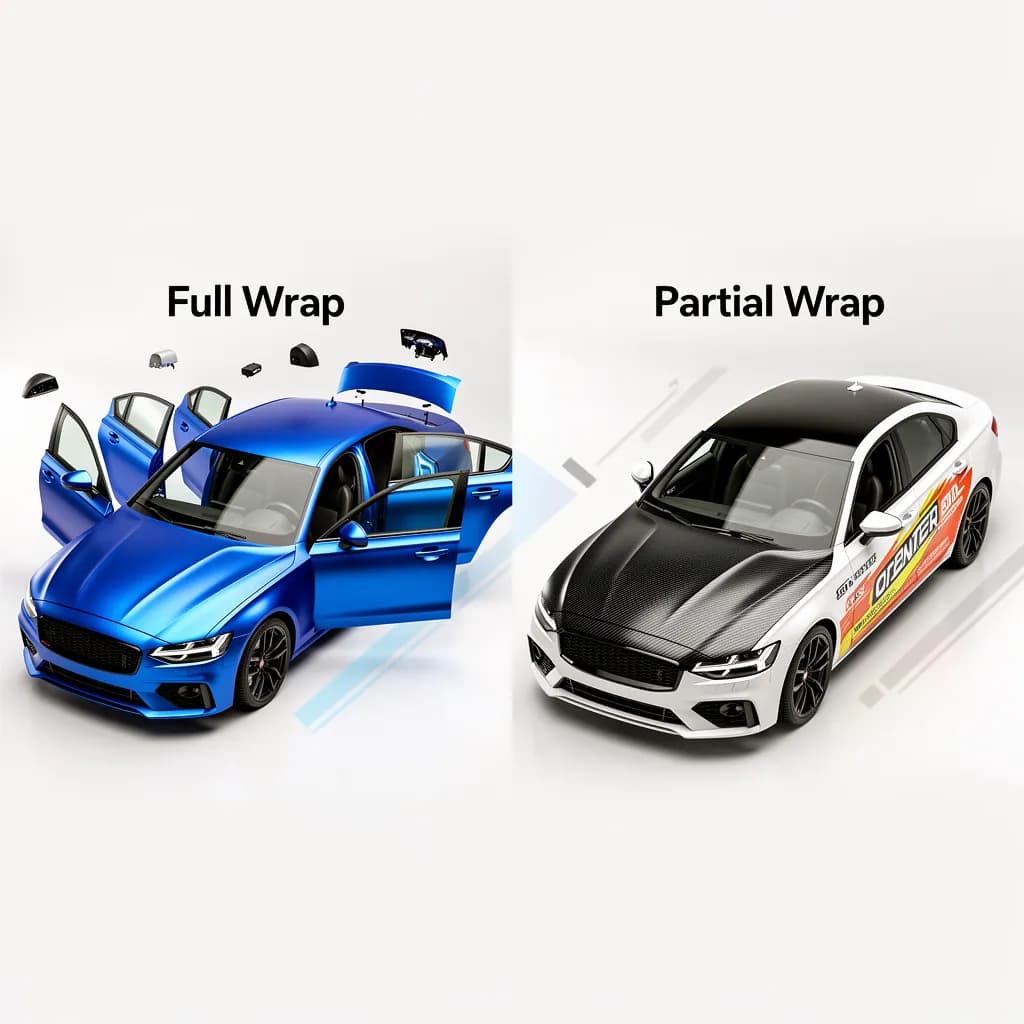
Full Car Wrap (Total Color Transformation)
A full car wrap covers every single painted surface on your vehicle. From the front fascia and side skirts to the rear diffuser and roof, your original factory paint completely vanishes.
- Best For: Drivers looking for a complete color change—like shifting from stock grey to stealth satin black, ultra-gloss metallic, or color-shifting iridescent film.
- The Visual Result: Flawless visual continuity. The entire body adopts one seamless, custom look with zero factory color showing through.
Partial Vehicle Wrap (Strategic High-Contrast Accents)
A partial vehicle wrap covers specific panels most commonly the roof, hood, side mirrors, trunk lid, or rear spoiler while keeping the factory paint visible on the remaining bodywork.
- Best For: Creating a high contrast, track-inspired aesthetic without wrapping the entire vehicle.
- The Visual Result: Dynamic focal points. Wrapping a roof in gloss black creates a popular "floating roof" effect, while a carbon fiber or satin hood gives your front end an aggressive street stance.
How Much Does It Cost to Wrap a Car?
Budget plays a massive role when deciding between different car wraps.
If you analyze how much it costs to wrap a car, the price breaks down into material square footage and labor complexity:
- Partial Wraps: Significantly lower entry cost. Perfect for high-impact visual upgrades on a targeted budget.
Full Wraps: Higher upfront investment, but offers 100% surface coverage and acts as a full protective barrier over your factory car paint.
Paint Protection Bonus: A quality full-body wrap shields your factory paint from stone chips, UV rays, light scratches, and road debris. And no—when removed properly by professionals, wrapping does not ruin paint.
How to Choose: What Job Are You Hiring Your Wrap to Do?
Choose a Full Wrap If:
- You want a total color overhaul: Trying to apply a partial wrap over a bright yellow base car with red accents usually leads to visual clutter. A full wrap gives you a clean slate.
- You want max resale value protection: Protecting every exterior panel keeps original factory paint in showroom condition underneath.
- You drive an exotic or sports coupe: Performance platforms like the Mercedes-AMG GT R Pro rely on full-body coverage to flow seamlessly across wide hips and complex aero surfaces.
Choose a Partial Wrap If:
- You want maximum impact per dollar spent: You get up to 80% of the custom visual attitude at a fraction of the cost of full coverage.
- You manage fleet or commercial vehicles: High-contrast graphics on truck wraps work best when placed strategically across side doors or tailgates for clear branding readability.
- You want targeted carbon or gloss accents: Hoods, roofs, and mirrors are high-visibility zones that dramatically change the car's silhouette.
Avoiding the #1 Wrap Mistake: Test Before You Buy
The fastest way to regret a wrap project is guessing how colors and panel breaks will look in real life before film touches metal
Instead of rolling the dice:
- craft Your Design : Use a real-time vehicle wrap customizer to test partial accents versus full-body shifts on your exact vehicle model.
- Ditch Outdated Blueprints: Modern AI wrap mockups vs Photoshop give you photorealistic lighting and depth rendering so you can see reflections and seams beforehand.
- Choose the Right Install Route: While wrapping a flat hood is doable as a project, curved bumpers require specialist techniques. Review our guide on DIY vs professional installation and step-by-step how to wrap a car instructions before buying your car wrapping tools.
Test Your Vision in Seconds with CarWrap AI
Stop guessing how film will look on metal. You can preview ultra-realistic custom finishes on your exact vehicle before spending a single dollar on materials or shop labor:
- Snap Your Car: Take a clear photo of your car from its best angle. (Pro tip: A 3/4 rear angle captures your roofline, hips, and bumper simultaneously).
- Upload & Describe: Drop your photo into CarWrap AI and type your idea—whether that’s a stealth satin black, high-gloss metallic, or a complex dual-tone accent.
Instant Render: Hit generate to watch the intelligence system craft an extraordinary, photorealistic wrap in seconds so you can lock in the ultimate look with total confidence.
Ready to Test Your Custom Car Design?
Stop guessing how your vehicle will look. Dial in your custom car design, compare partial vs. full layouts, and connect directly with top-rated car wrap near me installation studios to bring your vision to life.
Frequently Asked Questions
What is the difference between a full car wrap and a partial car wrap?
A full wrap covers every inch of exposed factory paint to give your car an entirely new identity. A partial wrap targets specific high-impact panels—like your roof, hood, or mirrors—to create a sharp, high-contrast look without changing the whole car.
Will vinyl wrap ruin my original factory paint?
Not at all. In fact, a professional wrap acts as a shield against sun damage, light scratches, and road debris. When removed correctly, your original factory paint looks just as fresh as the day the film went on.
How long will a custom wrap hold up on a daily driver?
Quality vinyl lasts anywhere from 3 to 7 years. Keeping your car clean with basic hand washes and parking out of intense heat or direct sun keeps the finish crisp and vibrant for the long haul.
How can I know I'll love the wrap before paying for materials and labor?
You don't have to guess. Use CarWrap AI to test your vision first. Snap a shot of your vehicle, upload it, and type in your design ideas. You get an instant, realistic preview of your machine before spending a dime.
Can I wrap over scratches, rock chips, or peeling paint?
Vinyl film clings tightly to your car's exact surface, so deep chips and rust texture will show right through. For a smooth, mirror-like result, any rough spots or peeling clear coat need to be sanded smooth before installation.